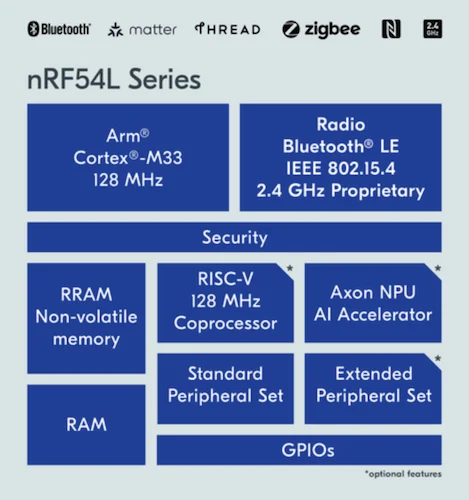
Nordic Semiconductor has announced its new nRF54L series, a wireless system-on-chip that embeds hardware-accelerated artificial intelligence into small, battery-operated industrial and consumer IoT devices. This new platform aims to run AI directly on the endpoint without draining power or overflowing memory.
The leading chip in the series, the nRF54LM20B, integrates an Axon Neural Processing Unit that accelerates AI inference locally. By offloading AI workloads from the main processor, this approach conserves energy and frees the MCU for communication and control tasks.
The NPU supports quantized neural operations with dedicated memory, enhancing speed while reducing power usage. Compared to prior solutions, the new chip can deliver up to seven times better performance and eight times more energy efficiency, extending battery life and cutting response times.
Developers can craft compact AI models using Nordic Edge AI Lab, a development suite that prepares, optimizes, and exports tiny models designed to run on constrained microcontrollers. These models, often under 5 KB, support tasks such as anomaly detection, gesture recognition, and simple pattern classification.
This toolchain significantly simplifies the workflow for embedded teams, even those without deep expertise in machine learning.
Alongside the AI accelerator, the nRF54LM20B includes a 128 MHz Arm Cortex-M33 MCU, a RISC-V coprocessor, and a low-power 2.4 GHz radio supporting Bluetooth LE, Thread, Zigbee, Matter, and proprietary protocols. With support for high-speed USB and many GPIOs, the chip targets a wide range of battery-powered IoT use cases.
On-device processing also reduces radio use and cloud dependency, enabling faster decisions and improved privacy for sensitive applications.
Nordic says the nRF54LM20B is currently in sampling with select customers, with broader availability expected in early Q2 2026. Ideal application areas include audio event detection, anomaly monitoring, and gesture or activity recognition where low latency and long battery life matter most.
Developers can also link on-device models with cloud lifecycle tools for remote updates, monitoring, and fleet management.