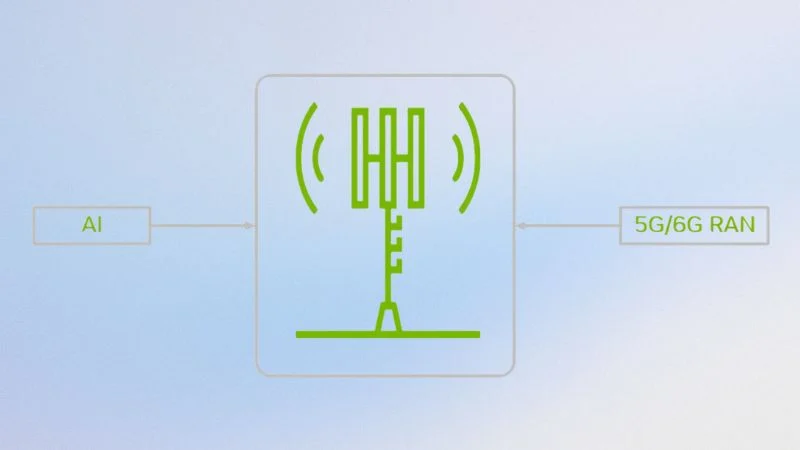
AI-RAN: Unified platform for RAN functions and AI workloads
AI-RAN (AI Radio Access Network) is emerging as a transformative architecture that embeds artificial intelligence directly into cellular networks. Major players like Nvidia, Nokia, Ericsson, Intel, Keysight, and Samsung are collaborating to shift AI-RAN from research to deployment, as highlighted at Mobile World Congress 2026.
AI-RAN: Unified platform for RAN functions and AI workloads
AI-RAN moves away from specialized RAN hardware toward general-purpose accelerated computing platforms (often GPU-based) that run both traditional radio processing and AI models simultaneously. It follows cloud-native principles: containerization, dynamic scaling, and resource sharing. When network load is low, unused capacity can handle AI tasks, improving utilization and enabling new revenue streams.
The AI-RAN Alliance defines three key domains:
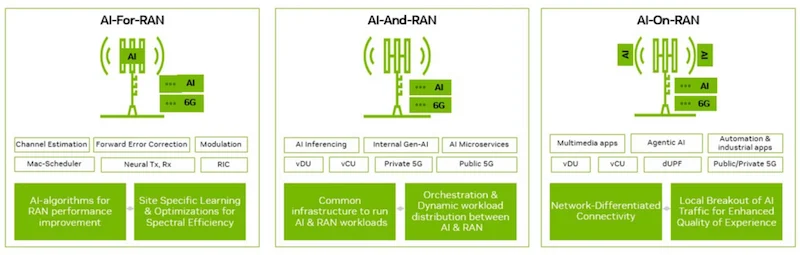
The three pillars of AI-RAN integration
Nokia and Nvidia demonstrated concurrent RAN and AI workloads on GPU platforms, including Massive MIMO supporting video streaming + AI captioning (trials with T-Mobile, Indosat Ooredoo Hutchison, SoftBank). Other operators (BT, Elisa, NTT DOCOMO, Vodafone) explore Nvidia Aerial for AI-RAN evolution.
Ericsson and Intel collaborate on AI-native infrastructure for 6G. Keysight, Samsung, and Nvidia provide validation tools for AI-driven radio functions. Ecosystem partners (Dell, Quanta, Supermicro, Red Hat) supply COTS servers, networking, and orchestration.
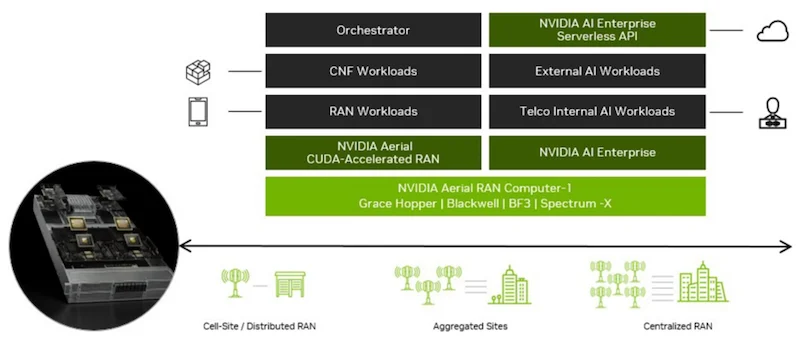
Nvidia Aerial + Nokia demo: AI + RAN on shared infrastructure
AI-RAN is a foundational step toward 6G, transforming RAN into a distributed computing platform for AI services, sensing, and real-time processing across billions of devices. Software-defined evolution enables continuous upgrades without hardware changes, supporting secure, intelligent, and interoperable networks.
With growing alliances and real-world trials, AI-RAN positions telecom as core AI infrastructure in the 6G era.