
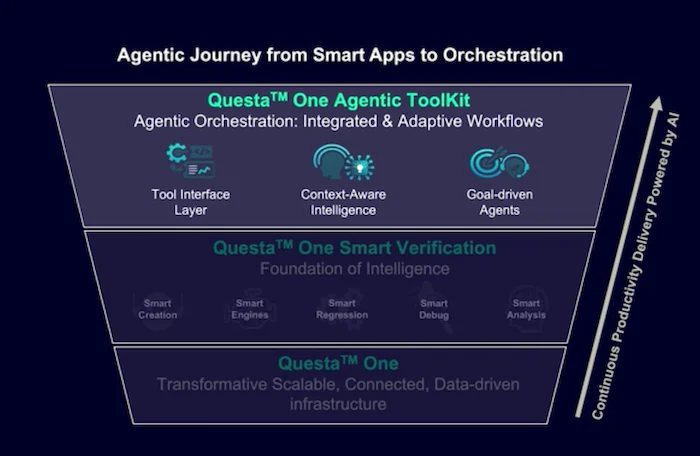
Overview of the Questa One Agentic Toolkit architecture
Siemens EDA has launched the Questa One Agentic Toolkit, integrating domain-scoped agentic AI workflows into the Questa One smart verification platform. Announced in February 2026 and now available via early access, the toolkit transforms traditional isolated tool interactions into intelligent, autonomous multi-step processes to speed up RTL creation, verification planning, execution, debugging, and trusted sign-off for advanced IC and ASIC designs.
Overview of the Questa One Agentic Toolkit architecture
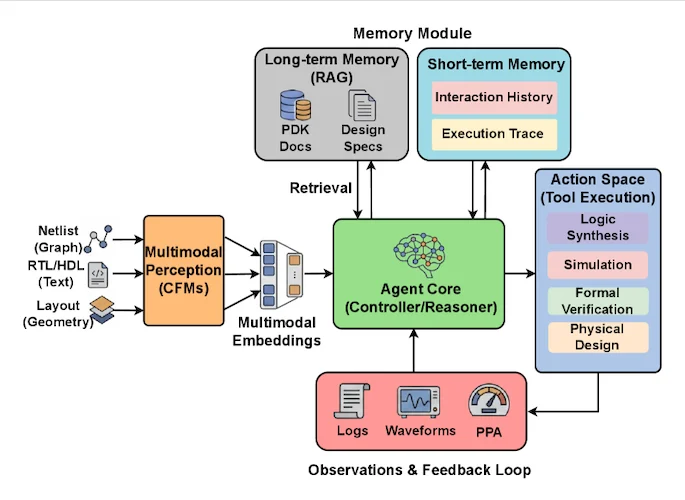
Agentic AI enables autonomous agents to observe, plan, reason, and act on complex verification tasks within defined governance boundaries, while keeping engineers in the loop for critical decisions. The toolkit uses generative AI (powered by Nvidia Llama Nemotron and NIM) and Model Context Protocols (MCPs) for real-time design state awareness. It is framework-agnostic, compatible with GitHub Copilot, Claude Code, or Siemens Fuse EDA AI.
Agentic AI cycle: observation, planning, action with feedback loop
The human-centered approach has already delivered significant productivity gains for early users, allowing engineers to focus on high-level expertise while AI orchestrates tools and adapts workflows.
Debug Agent example: correlating failure data across logs and waveforms
As part of Siemens' broader AI strategy (including Fuse EDA AI Agent for multi-tool orchestration), Questa One Agentic Toolkit positions verification engineers to handle future software-defined and 3D IC architectures more efficiently. Early access is open now, with broader availability expected soon.