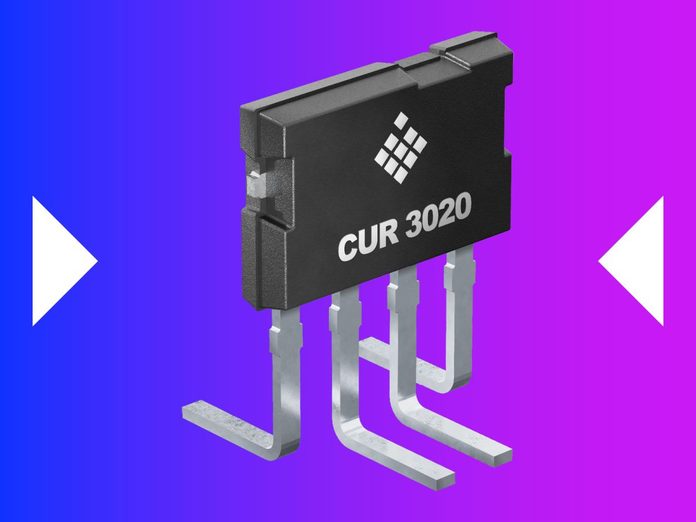
TDK Micronas CUR 3020 Current Sensor for Electric Vehicles
TDK Corporation has introduced the Micronas CUR 3020, a customer-programmable linear Hall-effect current sensor IC designed for high-power conversion systems. The device is intended for electric vehicle (xEV) traction inverters, auxiliary inverters, battery management systems and industrial current sensor modules, using a C-core magnetic concentrator.
TDK Micronas CUR 3020 Hall-effect current sensor IC
Key Characteristics
Technology: Linear Hall-effect sensor for C-core concentrators
Output: Voltage proportional to applied magnetic field
Quiescent voltage output (QVO): centred at 2.5 V (bidirectional), user-adjustable
Programmable sensitivity: 4.2 to 67.4 mV/mT
Bandwidth: selectable 250 kHz or 500 kHz
Sensitivity drift error: max. 1% from −40°C to 150°C
Offset drift error: max. 5 mV from −40°C to 150°C
Operating temperature: Automotive Grade 0, ambient up to 165°C (short periods)
Configuration: EEPROM for sensitivity and QVO programming
Package: 4-pin TO-92 (UM)
User-selectable output voltage clamps (enable/disable)
Broken-ground and broken-wire detection
Overtemperature diagnostics
High-sensitivity Hall element
The CUR 3020 is configured to minimise sensitivity and offset drift across the full automotive temperature range, making it suitable for the demanding thermal conditions of traction inverters.
Target Applications
xEV traction inverters
Personal mobility and auxiliary (AUX) inverters
Battery management and disconnect systems
Industrial current sensor modules (CSMs)
Wafers are manufactured at TDK’s facility in Freiburg, Germany. Samples are available on request.