



The new accelerated processing unit pairs with dual-band Wi-Fi 8 radios to deliver power-efficient, secure on-device AI inference to residential consumers.
Broadcom used CES 2026 to roll out a unified Wi-Fi 8 silicon stack aimed at the next wave of “AI smart home” networking gear: a compute-heavy access point that can do more than route packets and two radio front ends designed to simplify board design while tightening power budgets.
The launch centers on the BCM4918 accelerated processing unit (APU) and two Wi-Fi 8 (IEEE 802.11bn) dual-band radio SoCs, the BCM6714 and BCM6719, targeted at residential gateways, mesh nodes, and premium consumer access points.
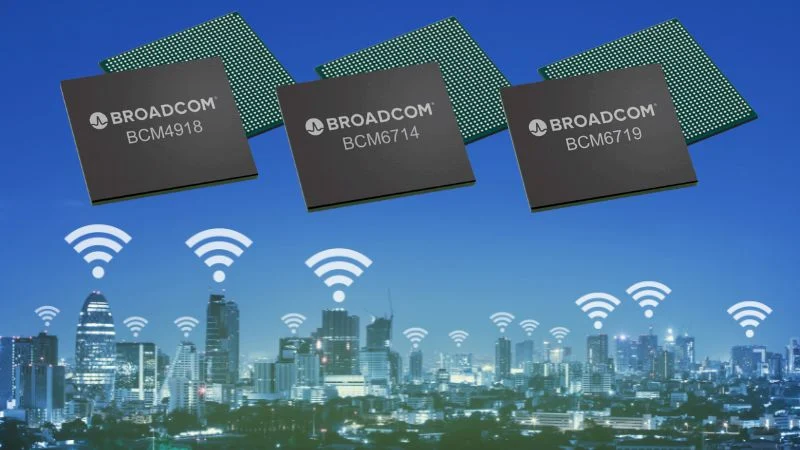 Broadcom's unified Wi-Fi 8 platform
Wi-Fi 8 is shaping up to be something of a reliability and latency cleanup effort, with work around 802.11bn emphasizing more consistent performance in interference-heavy deployments and lower worst-case latency. These considerations are important, given that our homes must compete with dense neighboring networks and support always-on streams from cameras, displays, and voice assistants. When jitter spikes, these devices may degrade quickly.
An AI-Capable Compute Core in the Access Point
At the heart of the platform is the BCM4918, positioned as a network processor that treats the access point as an edge compute node. The device integrates a quad-core Arm v8-compatible CPU complex alongside the company’s Broadcom Neural Engine (BNE) AI/ML core for on-device inference and acceleration.
For the “router as a computer” crowd, the supporting cast includes dedicated networking engines-including a dual-issue Runner packet processor-to offload wired and wireless data paths. That way, the CPU isn’t forced to touch every packet. Broadcom also integrated cryptographic protocol acceleration for security workloads.
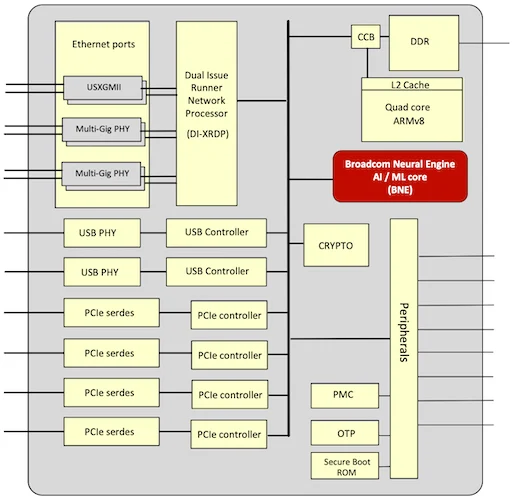
Block diagram of the BCM4918
That combination is a practical answer to two real design pressures.
First, as gateways add more software features-security inspection, parental controls, application prioritization, and mesh coordination-general-purpose CPU cycles get eaten by packet movement and encryption. Offload engines that can bypass the CPU for routine traffic free up headroom for higher-level analytics and control loops.
Second, if vendors actually want to run local inference in the router, they need predictable access to compute and memory bandwidth that doesn’t vanish whenever network load spikes. Broadcom is effectively presenting BCM4918 as a way to run AI-assisted optimization and management without turning the AP into a space heater or needing a separate companion AI chip.
On the integration front, Broadcom designed the BCM4918 to reduce system sprawl. The device's brief calls out integrated multi-gigabit Ethernet PHY interfaces, advanced memory interfaces, quad PCIe Gen3 ports, dual USB ports, and secure boot with enhanced encryption support. It is packaged as a 19 mm x 19 mm FCBGA part rated for 0°C to 70°C, consistent with high-end residential equipment that still needs a sensible thermal envelope.
Combining Dual-Band RF, Telemetry, and Efficiency
On the radio side of the announcement are the BCM6714 and BCM6719, both dual-band Wi-Fi 8 devices that combine 2.4-GHz and 5-GHz operation into a single piece of silicon. The BCM6714 is a three-stream, 2.4-GHz radio paired with a four-stream, 5-GHz radio, while the BCM6719 goes four-stream on both 2.4 GHz and 5 GHz. In practice, this is the kind of integration that can simplify residential AP layouts where dual-band support often means multiple chips and additional interconnects.
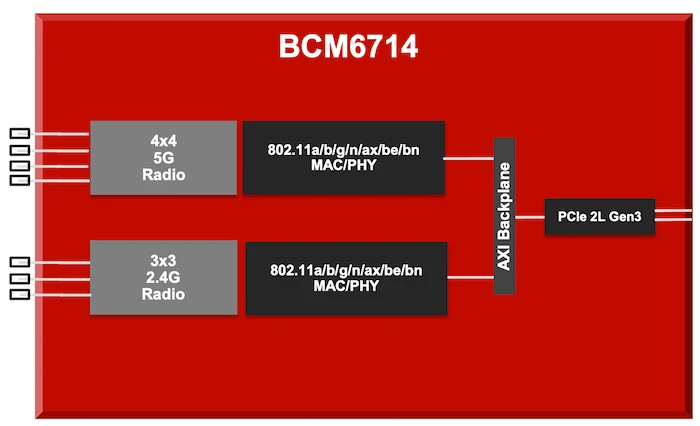 Block diagram of the BCM6714
Broadcom is also leaning into “fewer externals” in a very literal way. The company highlights on-chip, 2.4-GHz power amplifiers, which can reduce the external RF BOM and tuning and placement compromises, particularly in compact mesh nodes. The radios also include a hardware-assisted telemetry engine that delivers real-time network insights and analytics to feed edge-AI models for quality-of-experience measurement, security monitoring, and operational troubleshooting.
There’s a big focus on power, too. Broadcom calls out advanced eco-modes and power optimization with third-generation digital predistortion (DPD), which reduces peak power by 25%. Peak power is often what sets thermal design limits and worst-case adapter sizing, especially as radios burst under heavy contention. Cutting peaks by a quarter can translate into smaller heatsinking requirements, more stable temperatures in fanless enclosures, and more flexibility to allocate power budget to other parts of the platform, including local compute.
A Unified Wi-Fi 8 Stack for Tri-Band Gateways
What’s most notable about this platform is the way these parts fit together. The company describes a unified compute-and-connectivity architecture in which the BCM4918 provides the compute, security, and offload foundation, while the BCM6714/BCM6719 provides integrated dual-band RF and telemetry. For tri-band systems, Broadcom points to pairing these new dual-band devices with its previously announced BCM6718 Wi-Fi 8 radio to cover 2.4 GHz, 5 GHz, and 6 GHz with coordinated behavior across bands.
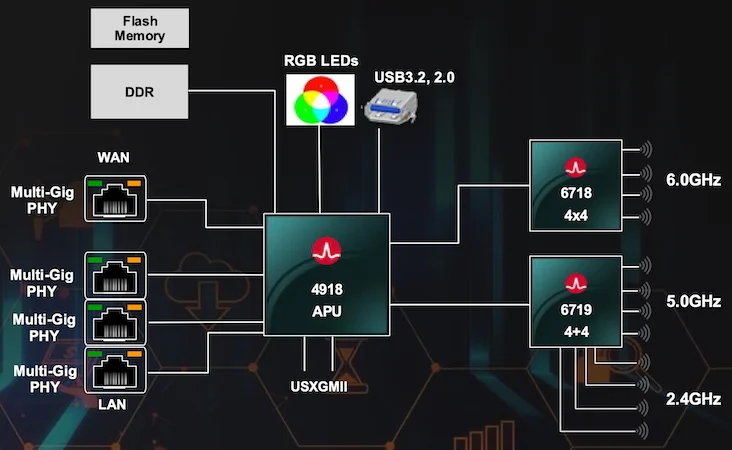 Broadcom calls these new offerings the "ultimate Wi-Fi 8 edge AI platform".
This is where the “AI smart home” framing begins to look less like empty marketing lingo and more like architecture. Broadcom is essentially arguing that Wi-Fi 8-era features such as seamless roaming, congestion avoidance, and inter-AP coordination benefit from fast local decisions backed by continuous telemetry. If the platform can measure performance in real time, run inference locally, and push adjustments through an integrated packet engine and radio stack, it reduces both the need for external components and the amount of system-level glue required to make a multi-AP home behave like one coherent network.
Broadcom says samples of the BCM4918 APU and the BCM6714/BCM6719 radios are available to early access customers and partners, with consumer products expected to follow on a typical next-gen Wi-Fi cadence as Wi-Fi 8 matures.