



Electronics News
Archive : 20 October 2026 год
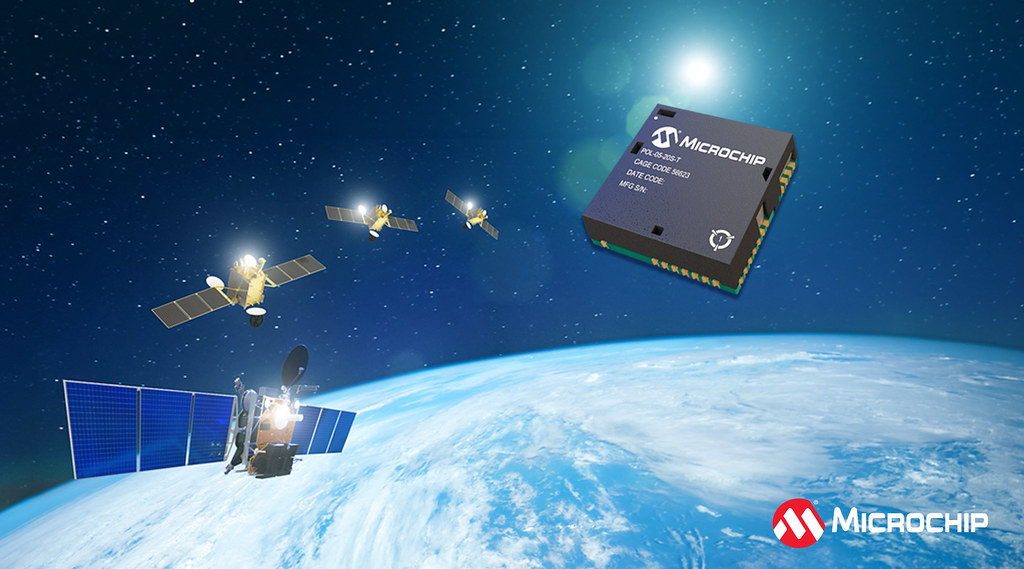
Microchip Technology has expanded its space power portfolio with the POL-05-20S-T, a radiation-tolerant point-of-load (POL) converter built on gallium nitride (GaN) power transistors. The module delivers up to 20 A of continuous output current and is intended to power the core voltage rails of FPGAs, microcontrollers and ASICs in satellites and other spacecraft, where processing loads change rapidly and every gram and cubic millimetre counts.
Modern on-board computers draw large, fast-changing currents from low-voltage core rails. Using GaN switches allows the POL-05-20S-T to combine high power density with a fast transient response, so designers can feed demanding processors without enlarging the power subsystem.
Key specifications
| Power stage | GaN power devices, synchronous buck topology |
| Control method | Current-mode control with output droop regulation |
| Output current | Up to 20 A continuous |
| Input voltage range | 4.75 V to 13.2 V |
| Output voltage | Adjustable, 0.7 V to 5 V |
| Total ionizing dose (TID) | Parameters specified before and after exposure up to 50 krad |
| Single-event effects (SEE) | Characterized up to LET 43 MeV·cm²/mg |
| Operating temperature | −55 °C to +100 °C at full load |
| Dimensions | 38.4 × 38.4 × 11.4 mm |
| Weight | 25 g |
| Mounting | Surface-mount package |
Control and protection features
- Remote sense inputs to compensate for voltage drop along PCB traces to the load;
- Soft start to limit inrush current at power-up;
- Enable pin for sequencing of multiple power rails;
- Power-good output for system supervision;
- Undervoltage and overvoltage protection;
- Droop regulation that keeps the output well-behaved during sudden load steps.
Designed for harsh orbital environments
The wide input range lets the converter sit on common intermediate bus voltages (5 V and 12 V) while generating anything from a sub-1 V processor core rail up to 5 V for peripheral logic. Electrical parameters are guaranteed both before and after a total ionizing dose of up to 50 krad, and the device has been characterized for single-event effects at linear energy transfer levels up to 43 MeV·cm²/mg, which covers typical requirements for LEO and many MEO missions. Full-load operation from −55 °C to +100 °C means the module can tolerate the large thermal swings a spacecraft experiences between sunlight and eclipse.
According to Microchip, space system designers are integrating ever more powerful digital processing, which increases demand for compact power stages that respond quickly to load changes and remain reliable under radiation. The POL-05-20S-T complements the company's existing family of radiation-tolerant power solutions for space applications.
TDK Corporation has introduced the Micronas CUR 3020, a customer-programmable linear Hall-effect current sensor IC designed for high-power conversion systems. The device is intended for electric vehicle (xEV) traction inverters, auxiliary inverters, battery management systems and industrial current sensor modules, using a C-core magnetic concentrator.
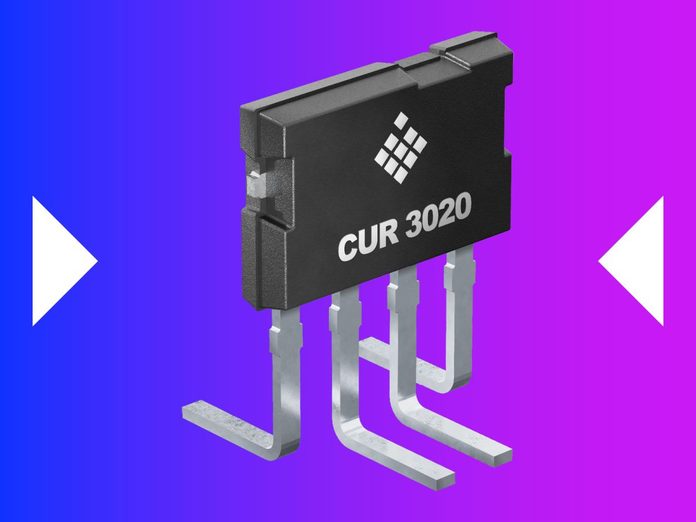
TDK Micronas CUR 3020 Hall-effect current sensor IC
Key Characteristics
- Technology: Linear Hall-effect sensor for C-core concentrators
- Output: Voltage proportional to applied magnetic field
- Quiescent voltage output (QVO): centred at 2.5 V (bidirectional), user-adjustable
- Programmable sensitivity: 4.2 to 67.4 mV/mT
- Bandwidth: selectable 250 kHz or 500 kHz
- Sensitivity drift error: max. 1% from −40°C to 150°C
- Offset drift error: max. 5 mV from −40°C to 150°C
- Operating temperature: Automotive Grade 0, ambient up to 165°C (short periods)
- Configuration: EEPROM for sensitivity and QVO programming
- Package: 4-pin TO-92 (UM)
- User-selectable output voltage clamps (enable/disable)
- Broken-ground and broken-wire detection
- Overtemperature diagnostics
- High-sensitivity Hall element
The CUR 3020 is configured to minimise sensitivity and offset drift across the full automotive temperature range, making it suitable for the demanding thermal conditions of traction inverters.
Target Applications
- xEV traction inverters
- Personal mobility and auxiliary (AUX) inverters
- Battery management and disconnect systems
- Industrial current sensor modules (CSMs)
Wafers are manufactured at TDK’s facility in Freiburg, Germany. Samples are available on request.
Source: Electronics For You