



Key phrase (70 chars max): NXP TJA1410/TJF1410: First 10BASE-T1S PMD transceivers for edge
NXP Semiconductors has announced the industry's first production-ready 10BASE-T1S Physical Medium Dependent (PMD) transceivers: TJA1410 for automotive and TJF1410 for industrial/building automation. These devices deliver scalable, low-cost 10 Mb/s single-pair Ethernet (SPE) in multidrop configurations to edge nodes like sensors and actuators.
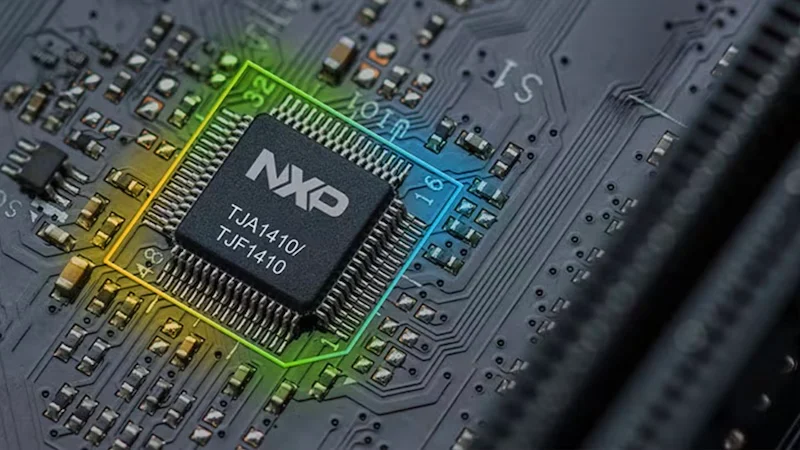
NXP TJA1410 (automotive) and TJF1410 (industrial) 10BASE-T1S PMD transceivers
Key Features and Architecture
The transceivers split the traditional Ethernet PHY: the digital part resides in an MCU or switch, while the analog front-end PMD handles transmit/receive over a standardized 3-pin OA interface. This reduces pin count, external components, and system complexity while maintaining full IEEE 802.3cg and Open Alliance TC14 compliance.
- Speed: 10 Mb/s multidrop Ethernet
- Cable length: Up to 100 m
- Nodes supported: Up to 32 on a single bus (TJF1410)
- Package: Compact 3 mm × 3 mm HVSON8
- Compliance: IEEE 802.3cg, OA TC14 (topology discovery, TC10/TC14 wake-up)
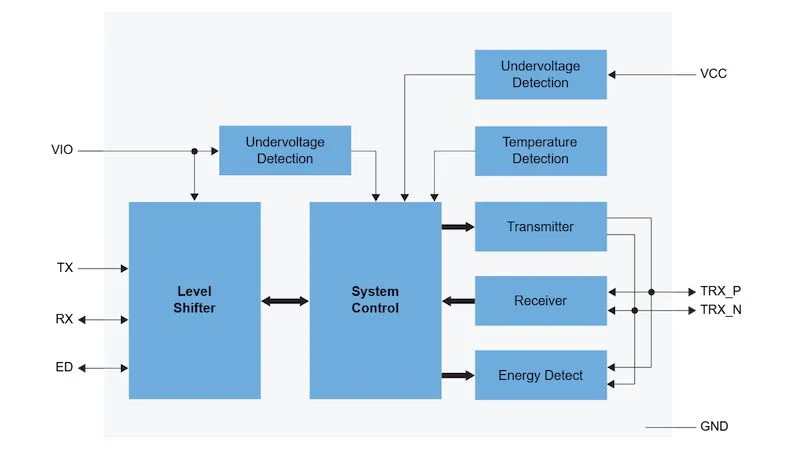
Block diagram showing split PHY with PMD transceiver
Automotive-Specific Advantages (TJA1410)
- ISO 26262 ASIL B functional safety compliant
- AEC-Q100 Grade 1 qualified
- Supports remote wake-up over data line (no extra wiring)
- Robust EMC with low-cost CAN FD common-mode chokes
Industrial Advantages (TJF1410)
- Optimized low quiescent current in power-down mode
- Power-over-data line compatibility
- Suitable for zonal/centralized architectures
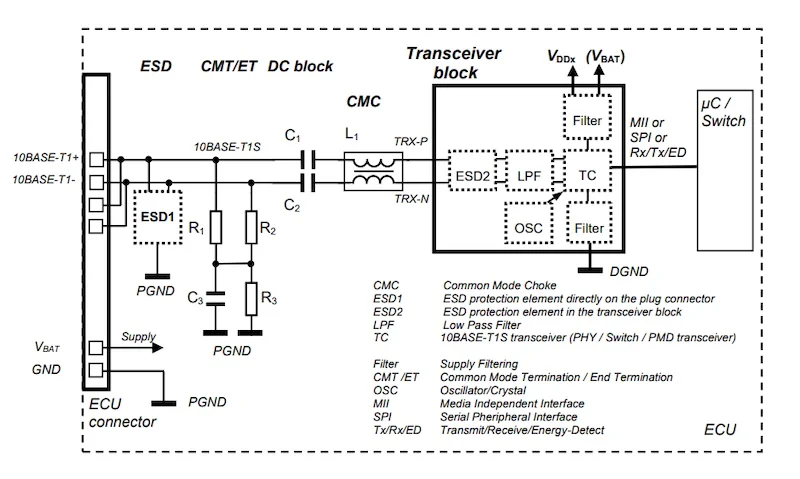
Multidrop bus topology with up to 32 nodes over single pair
Target Applications
These transceivers enable Ethernet connectivity at the lowest edge levels in software-defined vehicles (SDV), industrial automation, building management, and edge networks-replacing legacy fieldbuses while keeping IP-based communication, security, and scalability.
Already in production, customer integrations are advancing for next-gen platforms requiring cost-effective, unified Ethernet backbones.