Electronics News
Archive: 17 November 2026
On November 4, Infineon announced AURIX RC1, a new microcontroller platform for vehicles and robotics. It is the company's first MCU platform built on the open RISC-V architecture. Infineon presented the family concept at electronica in Munich (November 10–13) and plans to ship samples in the first half of 2027.
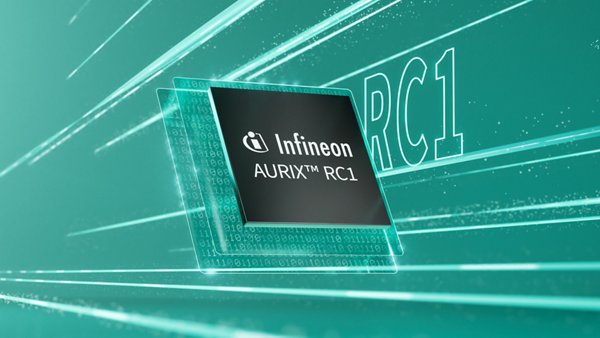
What we know
- Compute: depending on the device, up to 12 32-bit RISC-V cores and a parallel processing unit for edge AI
- Memory: up to 40 MB embedded
- High-end lineup: hybrid MCU/MPU devices with 64-bit cores
- Functional safety: up to ASIL D, the highest automotive level
- Cybersecurity: designed for ISO/SAE 21434 and the EU Cyber Resilience Act, ready for post-quantum cryptography
- Networking: CAN-XL, 10BASE-T1S and multi-gigabit Ethernet, with an integrated BRIGHTLANE Ethernet switch on selected devices
Why RISC-V
Infineon currently has two automotive MCU lines: AURIX on TriCore cores and TRAVEO T2G on Arm. AURIX RC1 merges them into one generation with a common architecture, from body and chassis control to battery management, powertrain and driver assistance. The modularity of RISC-V lets Infineon tailor the cores to each application while keeping code and tools portable across the family.
Software support
The platform is backed by the DRIVECORE ecosystem: AUTOSAR, open-source software and pre-integrated safety and security bundles. Developers can start writing and validating code on a virtual prototype before silicon is available, and Infineon promises AI-assisted tools for porting projects from AURIX and TRAVEO T2G.
Source: Infineon. Infineon microcontroller documentation is in our datasheet archive.
On November 4, STMicroelectronics introduced the STM32G5 series, mixed-signal microcontrollers for digital power supplies and motor control. ST says the new series delivers twice the compute performance of the STM32G4, and it is already in production. Target applications include power supplies for AI datacenters, robot drives, solar inverters, wind turbines and commercial drones.
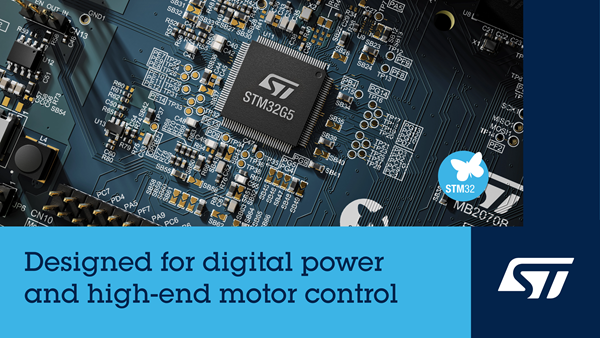
Key specifications
- Core: Arm Cortex-M33 at 280 MHz, 420 DMIPS and 1136 CoreMark, instruction and data cache
- Flash: 64 KB to 512 KB
- High-resolution timer: 12 channels, the first MCU with ST's enhanced HRTIM
- Analog: 12-bit ADCs, 12-bit DACs, op-amps and ultra-fast comparators
- Motor control: motor-control timers and a POSENC position encoder interface
- PLAy: a programmable logic array that replaces external glue logic
- Security: TrustZone, immutable STiRoT root of trust for secure boot and firmware update, crypto engine with post-quantum algorithm support, tamper detection
- Packages: QFN32 to LQFP128, including an LQFP variant with an exposed thermal pad
Why it matters
The high-resolution timer gives finer PWM control, so the STM32G5 can keep up with the high switching frequencies of silicon carbide (SiC) and gallium nitride (GaN) power stages. In drives, precise timing helps coordinate many motors at once: a humanoid robot hand can have up to 20 of them.
Tools and pricing
- NUCLEO-G564RE board with a 512 KB device in LQFP64
- B-G564E-MC1S motor control kit and B-G564E-DPOW1 digital power kit
- X-CUBE-DPOWER and X-CUBE-MCSDK libraries, support in STM32CubeMX2 and the new HAL2
Prices start at $1.034 in 10,000-unit quantities. ST plans to add dual-core devices to the series in 2027.
Source: STMicroelectronics. STM32 documentation is in our datasheet archive.