



Researchers from the Fraunhofer Institute for Digital Media Technology (IDMT) have demonstrated a system that uses structure-borne sound sensors attached to solar panels to estimate rainfall from the vibrations caused by raindrops. The approach turns existing photovoltaic modules into distributed rain gauges without moving parts.
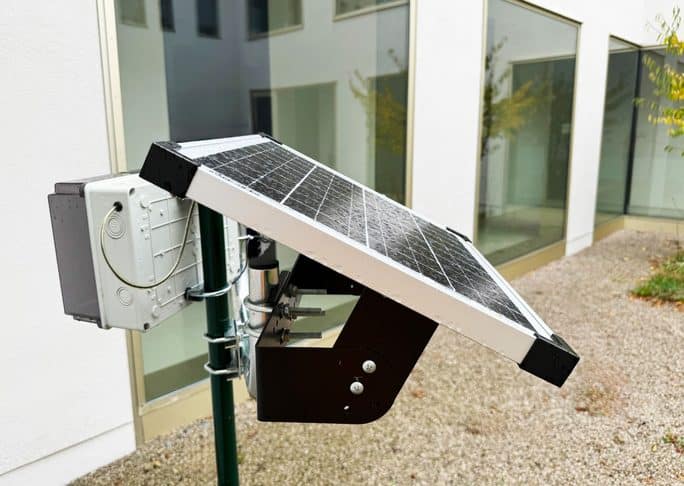
Fraunhofer IDMT lokalRAIN — vibration sensors on solar panels for rainfall measurement
Key Characteristics
- Sensing principle: structure-borne sound (vibration) sensors detect raindrop impacts on solar modules
- Processing: machine-learning algorithm running on an energy-efficient microcontroller at each sensor node
- Only compact processed measurement data is transmitted wirelessly
- Accuracy (light rain 2–5 mm/h): mean absolute deviation 1.88 mm/h — meets WMO Class C (max. allowed deviation 2 mm/h)
- Wireless range (field trials):
- up to 4 km in urban environments
- over 35 km in rural line-of-sight conditions
- No moving parts → potentially lower maintenance than conventional rain gauges
- Data from multiple nodes aggregated centrally for higher-resolution local rainfall maps
- Hardware developed by project partner Pan Acoustics
The system is intended to complement rather than replace traditional rain gauges. Current validation covers light rain; performance under heavy rainfall still requires additional training data.
Target Applications
- Urban digital twins and municipal control rooms
- Flood monitoring and early-warning systems
- Support for municipal infrastructure operators and firefighting services
- Dense local rainfall measurement networks using existing solar installations
The lokalRAIN project (Oct 2024 – June 2026) produced a working prototype under Germany’s ZIM programme. Further development is needed for sensor housing, electronics and expanded validation under heavy rain and varied environmental conditions.
Source: Electronics For You