



Vishay Intertechnology has introduced the XFD11KxxCA series of bidirectional XClampR flat-clamping transient voltage suppressors (TVS). These devices deliver high surge capability with a near-1.0 clamping ratio in a surface-mount DO-218AC package, making them ideal for protecting 12 V, 24 V and 48 V automotive and industrial power systems.
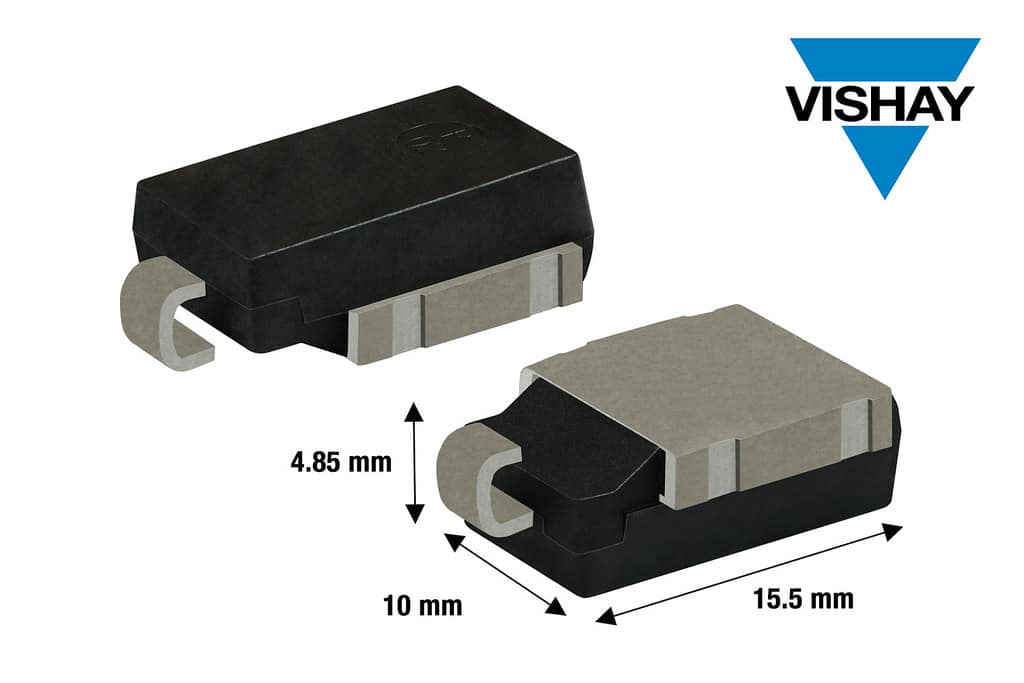
Vishay XFD11KxxCA series bidirectional flat-clamping TVS diodes
Key Specifications
- Peak pulse power: 11 kW (10/1000 µs)
- Peak pulse current: up to 207.1 A (10/1000 µs), 2140 A (8/20 µs)
- Stand-off voltage (VWM): 33 V to 85 V (15 variants)
- Breakdown voltage (VBR): 36.7 V to 104 V
- Maximum clamping voltage (VC): 40.6 V to 104.0 V
- Clamping ratio (VC/VBR): close to 1.0
- Leakage current: max. 10 µA at VWM
- Operating temperature: -55°C to +175°C
- Package: surface-mount DO-218AC
- Qualification: commercial-grade and AEC-Q101 automotive versions
The flat-clamping architecture and low dynamic resistance provide lower clamping voltage compared with conventional TVS devices in the same package, while supporting approximately 1.6× higher peak pulse current. This allows designers to use lower-voltage-rated downstream components (MOSFETs, capacitors, etc.), reducing cost and voltage guard bands.
Target Applications
- ADAS and autonomous driving control units
- On-board chargers, DC/DC converters, traction inverters
- Battery management systems (BMS)
- Body control modules, camera and radar power supplies
- Industrial automation, servo motors, energy storage
- AI/server hot-swap power and telecom supplies
The XFD11KxxCA series protects against transients from inductive load switching and lightning while maintaining stable performance across the full temperature range.
Source: Electronics For You